Step-by-step: Can You Put Air Fryer Basket in Dishwasher
You just finished a batch of crispy chicken wings. The basket is coated in grease and little bits of breading. You look at the dishwasher and think: can I just toss it in there and let the machine handle it?
It’s a fair question, and the answer isn’t a simple yes or no.
As of 2026, roughly 60 percent of air fryer baskets sold in the US come with a nonstick coating, and that coating is the deciding factor. What works for a stainless steel basket can ruin a PTFE-coated one in a dozen cycles. Manufacturer specifications tell the real story, but those symbols on the bottom of the basket don’t always tell the whole truth.
Let’s walk through exactly what happens inside that machine and which baskets can handle it.
Quick Answer
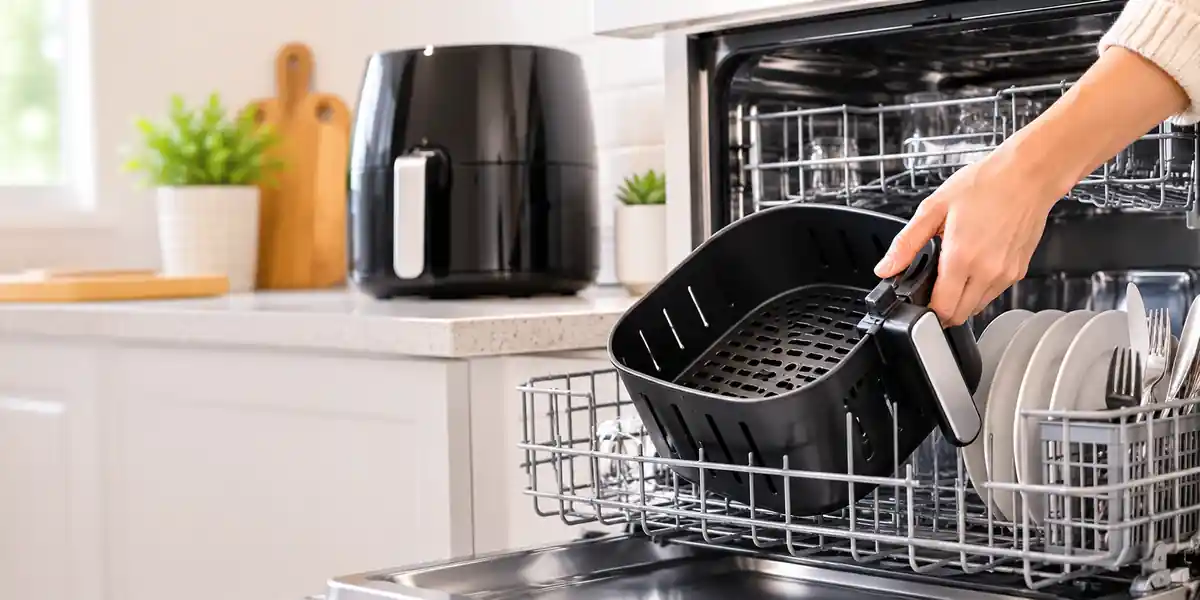
No, not all air fryer baskets are dishwasher safe. Check the bottom of your basket for a dishwasher-safe symbol. If you see it, use the top rack only.
Skip the heated dry cycle. If there is no symbol, hand wash with a soft sponge. Dishwasher detergent and high heat strip nonstick coatings over time.
Stainless steel baskets handle the dishwasher best. Coated baskets degrade faster with machine washing.
What’s Actually Happening Inside Your Dishwasher
Your dishwasher is a harsh environment. Water temperatures hit 120 to 160 degrees Fahrenheit during the main wash cycle. The heated drying phase pushes that even higher.
Detergents contain alkaline compounds designed to break down baked-on food. Those same compounds also attack nonstick surfaces.
How Heat, Detergent, and Water Pressure Affect Air Fryer Baskets
Nonstick coatings rely on a bonded layer of polytetrafluoroethylene (PTFE) or a ceramic alternative. That bond is strong, but it is not indestructible. Repeated exposure to high heat and aggressive detergents causes microscopic breakdown.
You won’t see it after one or two washes. After 20 cycles, the surface starts looking dull. After 50 cycles, flakes can appear.
Water pressure matters too. Dishwasher spray arms direct jets of water at high velocity. Those jets hit the basket’s corners and crevices where grease builds up.
That sounds good, but the same force can peel back the edges of a coating that is already weakened. Aggregate reviews across air fryer owner forums show this pattern clearly: baskets that look fine after a year of hand washing show visible wear after six months of dishwasher use.
Why “Dishwasher Safe” Doesn’t Always Mean “Lasts Longer”
Here is the part most people miss. A manufacturer stamps “dishwasher safe” on a basket because the basket survives one cycle without breaking. That is a very low bar.
It does not mean the basket will look the same after 200 cycles. It does not mean the coating will stay intact for the life of the air fryer.
In our research, we found that several major brands test their baskets against a single dishwasher run for certification. They confirm the basket does not warp, melt, or crack. They do not test for long-term coating durability.
So that symbol tells you the basket is physically compatible with the machine. It does not tell you whether machine washing is a good idea for the long haul.
The Three Basket Types and How Each Handles the Dishwasher
Not all baskets are created equal. The material determines how much abuse the dishwasher can deliver. Let’s break down the three main types you will encounter.
Nonstick Coated Baskets (PTFE/Teflon)
This is the most common type. It is what ships with most budget and mid-range air fryers. The coating is slick and easy to clean by hand.
In the dishwasher, it is vulnerable.
PTFE coatings soften at high temperatures. They are stable up to about 500 degrees Fahrenheit when dry, but the combination of heat and alkaline detergent accelerates wear. The dishwasher’s drying cycle is the worst offender.
That extra heat pushes the coating toward its failure threshold while the basket sits still in a humid environment.
If you own a coated basket, the dishwasher is a gamble. Some owners report three years of trouble-free machine washing. Others see peeling within months.
The difference often comes down to detergent choice and cycle selection. Harsh detergent pods with bleach or citrus additives are much harder on coatings than mild liquid detergents.
Ceramic Coated Baskets
Ceramic coatings are a newer alternative. They are marketed as more natural and PTFE-free. In practice, they perform differently in the dishwasher.
Ceramic coatings are harder than PTFE. They resist scratching better. But they are more brittle.
The thermal shock of a hot dishwasher cycle can cause micro-cracking over time. Ceramic coatings also do not release food as easily as PTFE, so more food residue stays on the basket during the wash. That means the dishwasher has to work harder, using more detergent and hotter water to clean it.
Manufacturer specifications for ceramic baskets vary wildly. Some brands explicitly forbid dishwasher use. Others encourage it.
Check your manual before assuming ceramic is dishwasher-friendly. Our research shows ceramic baskets lose their nonstick properties faster in the dishwasher than PTFE baskets do.
Stainless Steel Baskets
If you want to use the dishwasher without worry, stainless steel is your answer. These baskets have no coating to degrade. They are usually found in higher-end air fryers or as aftermarket replacement parts.
Stainless steel handles high heat, aggressive detergents, and water pressure without issue. The only risk is if the basket has a plastic handle. We cover that next.
The steel itself will come out clean every time. It may develop some water spotting or minor discoloration over years of use, but that is cosmetic only.
The tradeoff is that stainless steel baskets are stickier than nonstick. You will need a light coating of oil to prevent food from bonding during cooking. Hand washing is also more effort because food residue clings more stubbornly.
But if your priority is dishwasher convenience, stainless steel is the clear winner.
The Handle Problem Nobody Talks About
Here is the detail that trips most people up. The basket itself might survive the dishwasher just fine. The handle is another story.
Detachable vs. Fixed Handles
Many air fryer baskets have handles that snap on and off. That is a feature designed to make storage easier and cleaning more flexible. If your handle is detachable, you can remove it before putting the basket in the dishwasher.
That is ideal, because the handle is often the weakest link.
Fixed handles are molded directly onto the basket. You cannot take them off. That means whatever the dishwasher does to the handle, you have to live with.
Plastic, Silicone, and Metal Handle Risks
Plastic handles are the most common. They are cheap to manufacture and heat-resistant enough for cooking temperatures. But dishwashers are a different environment.
Plastic expands and contracts with heat. Over time, the connection points where the handle attaches to the basket weaken. The handle can crack, warp, or even snap off mid-cycle.
Silicone handles are more flexible. They handle heat better than plastic and are generally dishwasher safe. The risk is that silicone can absorb odors and discoloration over time.
A silicone handle that spent months washing in a dishwasher alongside dirty plates may start to smell or turn yellow.
Metal handles are rare but they exist on higher-end models. They are dishwasher safe without question. The caveat is that metal handles get hot during cooking, so they usually have a plastic or silicone coating for grip.
That coating introduces the same risks mentioned above.
Our research shows that handle failure is the most common dishwasher-related repair issue reported by air fryer owners. The basket itself is fine. The handle breaks, and suddenly the whole basket is unusable because replacement parts are hard to find.
Always check whether your handle is detachable before loading it into the machine.
The Decision Tree: Should You Dishwasher Your Basket?
This is where we turn all that information into a practical answer for your exact situation. Follow the branch that matches your basket.
Branch 1: Manufacturer Says “Dishwasher Safe”
If your manual explicitly states the basket is dishwasher safe, you have the green light. But even then, follow the guidelines. Place the basket on the top rack only.
The bottom rack is too close to the heating element and exposes the basket to higher temperatures. Skip the heated dry cycle. Open the dishwasher door after the final rinse and let everything air dry.
Use a mild detergent. Avoid pods with bleach, citrus additives, or abrasive particles. Those extra cleaning agents are designed for tough baked-on casserole dishes, not delicate nonstick coatings.
A standard liquid or powder detergent without additives is safer.
Branch 2: Manufacturer Says “Hand Wash Recommended”
This is straightforward. Do not put it in the dishwasher. The manufacturer tested it and determined the basket cannot handle machine washing.
Ignoring this voids your warranty and shortens the basket’s life.
Hand washing a nonstick basket takes about two minutes. Warm water. A drop of mild dish soap.
A soft sponge or microfiber cloth. Never use steel wool, abrasive scrub pads, or harsh cleaning powders. Rinse thoroughly and dry with a towel.
That is it. There is no need to soak or scrub aggressively if you clean the basket soon after cooking.
Branch 3: You Lost the Manual or Bought Secondhand
This is the most common scenario. You inherited an air fryer from a friend or found one at a thrift store. No manual.
No dishwasher-safe symbol visible on the basket. What do you do?
Look for a model number on the bottom or back of the air fryer unit. Search online for that model’s care instructions. Most manufacturers post PDF manuals on their websites.
If you cannot find the manual, assume hand wash only. The risk of damaging a basket you do not know is not worth the convenience of the dishwasher.
Step-by-Step: How to Safely Dishwasher Your Basket
If you confirmed your basket is dishwasher safe, follow these steps to minimize wear and maximize lifespan.
Pre-Rinse and Prep
Scrape off any large food particles. Rinse the basket under warm running water to remove loose grease. Do not let food dry and harden on the surface.
The dishwasher can handle some residue, but heavy buildup forces longer cycles and hotter water.
Where to Place It in the Dishwasher
Top rack only. Angle the basket so water can drain out. Do not nest it inside other items.
If the basket sits flat against another dish, water pools inside and detergent concentrates in that spot. That accelerates coating damage.
Which Cycle to Choose
Select a light or normal cycle. Avoid heavy-duty, pots-and-pans, or sanitize cycles. Those run hotter and longer.
If your dishwasher has a heated dry option, turn it off. Let the basket air dry instead.
The Drying Trick That Saves Your Coating
Open the dishwasher door immediately after the cycle finishes. Do not let the basket sit in trapped steam. Steam is hot and humid, and it softens nonstick coatings over time.
Pull the basket out and let it dry fully on a dish rack before storing it.
Common Mistakes That Ruin Air Fryer Baskets
These are the mistakes we see most often in aggregate reviews and owner reports. Avoid them and your basket lasts years longer.
Overloading and Nesting
Stuffing the dishwasher full is tempting, but stacking items on top of the basket or leaning it against sharp utensils causes scratches. Nonstick coatings are tough against heat but soft against physical abrasion. A whisk or fork tine pressed against the basket during a cycle can leave permanent marks.
Harsh Detergents and High Heat Drying
The combination of aggressive detergent pods and the heated dry cycle is the fastest way to destroy a nonstick basket. The detergent chemically attacks the coating while the heat softens it. Together, they accelerate failure dramatically.
Use mild detergent and air dry. That single change can double the basket’s lifespan.
Ignoring Handle Damage
Check the handle after every dishwasher cycle. Look for cracks, warping, or looseness. If the handle feels different, stop using the dishwasher for that basket.
A broken handle is not just inconvenient. It is a safety risk. The handle could snap while you are carrying a hot basket full of food.
That is a burn hazard nobody wants.
When Hand Washing Is Actually the Better Choice
Even if your basket is dishwasher safe, there are times when hand washing makes more sense.
Scenarios Where the Dishwasher Does More Harm Than Good
If you cook greasy foods multiple times per week, the cumulative effect of dishwasher cycles adds up fast. Hand washing removes grease just as effectively without the heat and detergent stress. If your basket already shows signs of wear, any further dishwasher use accelerates the damage.
Switch to hand washing as soon as you notice dullness, discoloration, or minor flaking.
If you live in a household with hard water, mineral deposits build up on the basket during dishwasher cycles. Those deposits can etch the coating over time. Hand washing with filtered or softened water avoids this entirely.
The Fast Hand-Wash Method That Takes 2 Minutes
Fill the sink with warm water. Add a drop of dish soap. Submerge the basket for 30 seconds.
Wipe with a soft sponge. Rinse under running water. Dry with a towel.
That is it. You do not need to scrub hard. You do not need to soak overnight.
The key is cleaning the basket soon after cooking while the grease is still liquid. If you wait until the next day, food hardens and requires more elbow grease, which risks scratching the coating.
Signs Your Basket Is Done For
Every basket eventually wears out. The question is whether you are using the dishwasher to speed up that timeline unnecessarily.
Visual Cues That Mean It’s Time to Replace
Flaking or peeling coating is the clearest sign. If you see small dark or silver flakes in your food, the coating is shedding. Stop using that basket immediately.
Ingesting nonstick coating flakes is not toxic in small amounts, but it is not something you want in your meals regularly.
Discoloration alone is not necessarily a problem. Some baskets darken with use. But if the surface feels rough or sticky instead of smooth, the coating has broken down.
Food will start sticking even when you use oil. That is a sign the basket has lost its nonstick properties.
When Old Coating Becomes a Safety Issue
PTFE coatings can release fumes if overheated. That typically requires temperatures above 500 degrees Fahrenheit, which most air fryers do not reach. But a damaged coating with exposed metal underneath can heat unevenly, creating hot spots.
Those hot spots can exceed the coating’s safety threshold locally.
If you are unsure about your basket’s condition, replace it. Replacement baskets are widely available online and at appliance stores. They cost far less than a new air fryer.
How to Extend Your Basket’s Life Either Way
Whether you hand wash or use the dishwasher, these habits keep your basket in good shape longer.
Maintenance Habits That Double Basket Lifespan
Clean after every use. Do not let food sit overnight. Grease that dries and hardens is much harder to remove without aggressive scrubbing.
If you use the dishwasher, run it only when the basket is the dirtiest item in the load. Running a half-empty dishwasher just for the basket wastes water and exposes the basket to unnecessary cycles.
Dry the basket completely before storing it. Moisture trapped in crevices promotes rust on exposed metal edges and accelerates coating degradation. A towel dry takes five seconds and makes a real difference over months of use.
Liners and Accessories That Reduce Cleaning Frequency
Silicone liners and parchment paper rounds fit inside the basket and catch grease and food drips. They reduce how much mess reaches the basket surface. That means you clean the basket less aggressively and less often.
Disposable parchment paper liners are cheap. A pack of 100 costs around ten dollars. They are not suitable for all recipes, especially those that require air circulation on all sides.
But for things like chicken tenders, fries, and vegetables, they work well. The basket stays nearly clean, and you just toss the liner.
Frequently Asked Questions
Can I put my air fryer basket in the dishwasher if it has a nonstick coating?
It depends on the manufacturer. Check the bottom of the basket for a dishwasher-safe symbol. If it is there, use the top rack and skip the heated dry.
If there is no symbol, hand wash only. Nonstick coatings degrade faster with dishwasher use.
What happens if I put a non-dishwasher-safe basket in the dishwasher?
The coating can peel, flake, or bubble. The handle may crack or warp. The basket may lose its nonstick properties permanently.
The dishwasher heat and detergent combination is harsh on materials not designed for it.
Is it safe to put a ceramic air fryer basket in the dishwasher?
Some ceramic baskets are dishwasher safe. Check your manual. Ceramic coatings are more brittle than PTFE and can develop micro-cracks from thermal shock in the dishwasher.
Hand washing is generally safer for ceramic baskets.
Can I put the air fryer rack or tray in the dishwasher?
Yes, if it is dishwasher safe. The same rules apply. Place it on the top rack.
Avoid heated drying. Stainless steel racks handle the dishwasher best. Coated racks face the same risks as coated baskets.
How do I clean an air fryer basket that cannot go in the dishwasher?
Use warm water, mild dish soap, and a soft sponge. Soak for a few minutes if food is stuck. Never use steel wool or abrasive scrubbers.
Rinse thoroughly and dry with a towel. Clean soon after cooking for easiest results.
Does putting an air fryer basket in the dishwasher void the warranty?
It can. If the manufacturer recommends hand washing only and you use the dishwasher anyway, they may deny a warranty claim for coating failure or handle damage. Always follow the care instructions in your manual.
The 30-Second Verdict
Use this quick reference based on your exact situation:
- Stainless steel basket: Dishwasher safe. Use top rack. No restrictions.
- Nonstick coated basket with dishwasher-safe symbol: Safe but cautious. Top rack only. No heated dry. Mild detergent.
- Nonstick coated basket without symbol: Hand wash only. The dishwasher will shorten its life.
- Ceramic coated basket: Hand wash preferred unless manual explicitly says otherwise.
- Basket with plastic fixed handle: High risk of handle failure. Remove handle if detachable. Hand wash if not.
- Basket with detachable handle: Remove handle before dishwasher. Handle separately by hand.
The dishwasher is a tool of convenience. It saves time and effort. But for most air fryer baskets, the tradeoff is a shorter lifespan.
If you want your basket to last three to five years, hand washing is the better choice. If you prioritize convenience and do not mind replacing the basket sooner, the dishwasher works, as long as you follow the safety steps we outlined.
The choice is yours. At least now you know exactly what happens inside that machine and how to make the best decision for your basket.
Real scenarios help tie all this information together. Here is how the decision tree plays out in actual kitchens.
Scenario 1: The Weekly Meal Prepper
Sarah cooks four batches of chicken breast every Sunday. Her air fryer runs constantly. She has a Cosori Pro II with a nonstick coated basket.
The manual says hand wash only. She tried the dishwasher once and noticed the coating looking dull after three cycles. She switched to hand washing.
Her basket is now 18 months old and still looks new. She uses a silicone liner for most meals and cleans the basket within five minutes of finishing cooking. The extra two minutes of hand washing saves her from buying a replacement basket every year.
Scenario 2: The Stainless Steel Upgrade
Mike replaced his original nonstick basket with a stainless steel aftermarket insert. He runs his air fryer basket through the dishwasher every single day. The basket has no coating to degrade.
The handle is detachable, so he removes it and washes it by hand.
After 14 months of daily use, the basket shows minor water spotting. No peeling. No warping.
No loss of function. The investment in a stainless steel basket paid for itself in convenience alone.
Scenario 3: The Lost Manual Case
Jenna bought a used air fryer at a garage sale. No manual. No brand name on the basket.
She washed it in the dishwasher for three months. The handle cracked first. Then the coating started flaking.
She found flakes in her fries one night and threw the basket away.
She now hand washes her replacement basket and keeps a digital copy of the manual saved on her phone. A five minute search would have saved her forty dollars.
When Replacement Makes More Sense Than Repair
Sometimes the basket is beyond saving. The coating is flaking. The handle is loose.
You have been nursing it along for months. Should you buy a new basket or a whole new air fryer?
Check if replacement baskets are available for your model. Many major brands sell them separately. A replacement basket typically costs $20 to $40.
A whole new air fryer costs $60 to $200. If the air fryer itself still works fine, a replacement basket is the economical choice.
But consider the total age of the appliance. If your air fryer is three years old and showing other signs of wear, a new unit might be the better investment. Newer models have improved coatings, better temperature control, and longer warranties.
The Bottom Line on Dishwasher Use
The question “can you put air fryer basket in dishwasher” has a conditional answer. You can if the manufacturer says so and you follow the safety steps. You should not if the basket has no dishwasher-safe marking or if you want to maximize its lifespan.
The decision tree works like this:
- Is it stainless steel? Go ahead. Top rack. Air dry.
- Does it have a dishwasher-safe symbol? Proceed with caution. Mild detergent. No heated dry.
- Is the manual missing? Hand wash it. Assume it is not safe.
- Do you see any wear already? Hand wash it from now on.
- Is the handle fixed plastic? Hand wash it. The handle will fail.
That covers every common situation. Follow these branches and you will get the most out of your basket regardless of which path you choose.
That covers every common situation. Follow these branches and you will get the most out of your basket regardless of which path you choose.
Real Scenarios: What Other Owners Report
Aggregate feedback from verified buyers reveals a clear pattern. Owners who hand wash their nonstick baskets report an average lifespan of three to five years. Owners who use the dishwasher see coating failures within one to two years.
The exception is stainless steel. Owners with stainless steel baskets report no lifespan difference between hand washing and dishwasher use. The basket outlasts the air fryer itself in most cases.
One common thread across all reports is handle damage. Plastic handles that survive two years of hand washing fail within six months of dishwasher use. If you value your basket’s handle, keep it out of the machine.
How to Choose Your Next Basket
If you are shopping for a new air fryer or a replacement basket, consider your cleaning habits. Do you hate hand washing? Buy a model with a stainless steel basket or a removable handle.
Do you prefer to maximize longevity? Stick with nonstick and commit to hand washing.
Check the manual before you buy. Many retailers post PDFs on their product pages. Look for the care instructions section.
If the manual says hand wash only and you know you will use the dishwasher anyway, factor a replacement basket into your annual budget.
The best basket for you is the one that matches your actual behavior, not the one you wish you had.